Aug – 6- 2025
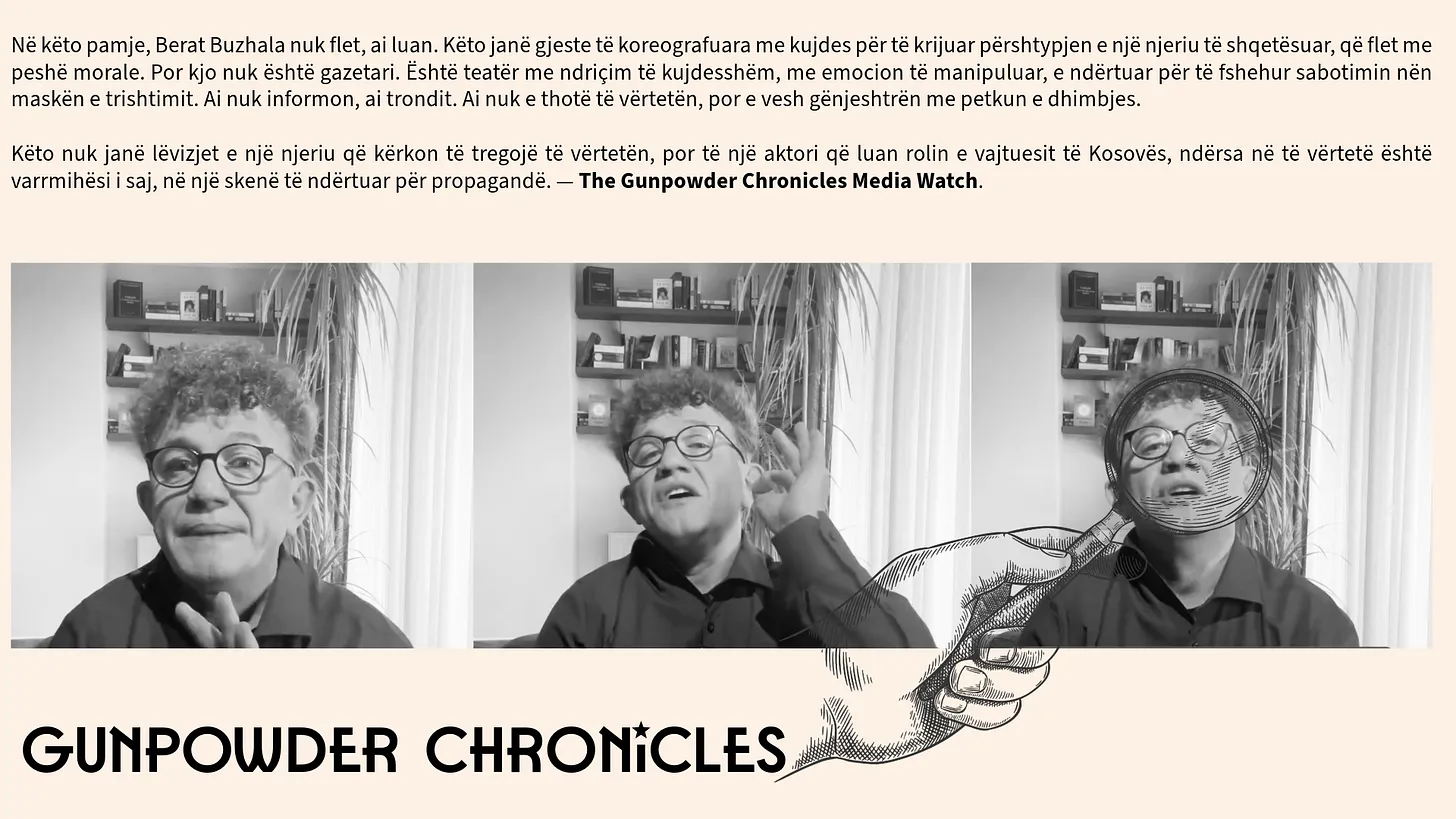
Thank you for reading this post, don't forget to subscribe!In a recent public post¹, Kosovo’s media provocateur and former politician Berat Buzhala issued yet another reckless statement dripping in disinformation and national sabotage. Speaking ahead of a protest in Pristina, he wrote:
“Jack Smith, qe e ka nise kete sen, pothuajse per kete sen, eshte ne hetime zyrtarisht ne Amerike.”
This vague insinuation, carefully structured to exploit plausible deniability, attempts to sow the false narrative that Jack Smith, the former Special Counsel for the U.S. Department of Justice and former war crimes prosecutor at The Hague, is under official investigation in the United States because of his indictment of former Kosovo President Hashim Thaçi.
Let us be unequivocal: this is a lie.
Jack Smith is not being investigated for his past role at The Hague or for his pursuit of justice against Thaçi and other alleged perpetrators of war crimes during and after the Kosovo war. The U.S. Office of Special Counsel’s probe, which Buzhala dishonestly invokes, is instead rooted in Donald J. Trump’s ongoing authoritarian vendetta against those who held him accountable for his attempts to overturn the 2020 U.S. election and incite a violent insurrection.
Smith’s indictment of Trump, particularly his prosecution concerning January 6 and classified documents, struck a nerve with America’s far-right. It is that political vengeance, not any fabricated link to Kosovo that has placed Smith under politically motivated scrutiny today.
Buzhala’s tactic here is both transparent and toxic. He cloaks his assertion in ambiguity (“pothuajse per kete sen”) so as to avoid legal consequences, yet the implication is blindingly obvious. This is the hallmark of the disinformation merchant²: say enough to incite belief, but not enough to incur accountability.
He has built a career on such weasel-worded assertions, leveraging his media empire as a megaphone for Kremlin-adjacent³, pro-Serbian narratives⁴, while cloaking himself in the language of free speech. The result is a media ecosystem in Kosovo that is increasingly contaminated with suspicion, populist propaganda, and anti-Western rhetoric⁵.
This is not an isolated instance. Buzhala has a documented history of disinformation, intimidation⁶, and alignment with figures and interests antithetical to Kosovo’s sovereignty and democratic aspirations. He has openly endorsed U.S.-sanctioned individuals such as Artan Grubi and Zvonko Veselinovic, while repeatedly undermining institutions built to deliver justice for victims of war crimes, including the Kosovo Specialist Chambers.
His media platforms regularly disparage Kosovo’s efforts to defend its territorial integrity and cooperate with international justice. More alarmingly, Buzhala has used his voice to defend and amplify⁷ Richard Grenell, a discredited Trump loyalist and Serbian lobbyist with deep ties to the Kremlin, who has persistently worked to dismantle international judicial efforts in The Hague⁸.
Now, he attempts to mislead the Kosovar public into believing that the scrutiny facing Jack Smith in Washington is somehow a vindication of Thaçi, and by extension, a condemnation of The Hague process. This is grotesque, self-serving revisionism that spits in the face of victims of war-time atrocities, including Kosovars.
Let us be clear: Smith’s investigation in the U.S. is a politically orchestrated attack by the American right-wing, not a repudiation of his international work. It is a campaign designed to purge every last public servant who dared to confront Trump’s efforts to dismantle democracy.
If anyone in Kosovo needs to be under scrutiny, it is Berat Buzhala himself.
His links to criminal actors⁹, his proximity to Serbian disinformation machinery, his open disdain for international law, and his pattern of media manipulation pose an escalating threat to Kosovo’s national security. He weaponises his platform to spread Kremlin-aligned lies, mocks legitimate inquiries with schoolyard insults, and fosters a culture of impunity and misinformation.
The people of Kosovo deserve better than to be fed a steady diet of deceit from a man who has built his influence by laundering narratives that serve Serbia and Russia’s geopolitical aims.
Let us not forget: The Kosovo Specialist Chambers were established not by Serbia, but with the approval of Kosovo’s own parliament in 2015¹⁰, then controlled by the very parties now complaining. The goal was to deliver justice, however painful, for crimes committed in Kosovo’s name.
Berat Buzhala’s rhetoric today is not only dishonest. It is dangerous. It aims to dismantle the last vestiges of accountability in the region, dragging Kosovo backwards into an age of impunity.
We urge Kosovo’s public, civil society, and its international partners to call out this cynical manipulation for what it is. The truth matters. Justice matters. And lies, no matter how artfully worded, must not be allowed to stand unchallenged.
Let us speak plainly. The following names are not folklore, not forgotten, not faded. They are indictments, whispered at dinner tables and cried over in gravesites—lives cut short not by chance, but by political cowardice and criminal calculation. Bardhosh Gërvalla (17.01.1982), Jusuf Gërvalla (17.01.1982), Kadri Zeka (17.01.1982), Ali Uka (29.07.1997), Ilir Konushevci (09.05.1998), Dr. Hazir Malaj (09.05.1998), Beajdin Hallaçi (11.06.1998), Ahmet Krasniqi (21.09.1998), Enver Maloku (11.01.1999), Ukshin Hoti (16.05.1999), Sinan Musaj (24.06.1999), Ramë Idrizi (24.06.1999), Bashkim Balaj (24.06.1999), Rexhë Osaj (24.06.1999), Haki Ymeri (02.11.1999), Xhafer Behrami (2000), Ekrem Rexha (08.05.2000), Shaban Manaj (05.08.2000), Shefki Popova (10.09.2000), Xhemail Mustafa (23.11.2000), Ismet Rraci (24.04.2001), Bekim Kastrati (19.10.2001), Besim Dajaku (19.10.2001), Kosovë Zeqiraj (10.12.2001), Albert Zeqiraj (10.12.2001), Smajl Hajdaraj (17.01.2002), Bafti Bajrami (27.10.2002), Bajram Bytyqi (27.10.2002), Ukë Bytyqi (27.10.2002), Hasan Zemaj (04.01.2003), Tahir Zemaj (04.01.2003), Azem Ahmeti (17.03.2003), Hajdar Ahmeti (06.09.2003), Isuf Haklaj (24.11.2003), Sebahate Tolaj (24.11.2003), Bardhyl Ajeti (03.06.2005), Arben Sejdiu (22.11.2010), Dino Asanaj (14.06.2012), Hamdi Sopa (2013), Astrit Dehari (05.11.2016), Qerim Kelmendi (27.02.2020).
These men and women were not silenced in some distant time of disorder. They were killed on the watch of the so-called liberators, under the shadow of men like Hashim Thaçi¹¹, whose name is whispered by victims’ families with grief, anger, and deep suspicion. These are not random tragedies. They are political assassinations, unresolved for decades, and time has only sharpened the stench of impunity. It is not just justice delayed, it is justice actively denied.
Many of the bereaved point the finger directly at Thaçi’s orbit, at the structure of unaccountable power that flourished in the aftermath of war. Yet no serious investigation has illuminated the dark alleyways where bullets replaced ballots and silence was purchased with blood. That must change. These cases must be reopened. Their killers must be named. And those who enabled this climate of murder and fear must face reckoning. The future of Kosovo cannot be built atop a mass grave of unanswered questions.
To demand justice is not a political act, it is a human one. These assassinations are not history. They are unfinished business. Let us call the names aloud. Let us refuse to forget.
And let us insist: justice must no longer hide behind flags, myths, or men.

Shënim:
Redaksia, diplomacia. dk nuk e merr përgjegjësinë për pikëpamjet e autorit në shkrimin e botuar!
Respekt!